 Join Our WhatsApp Channel for Updates!
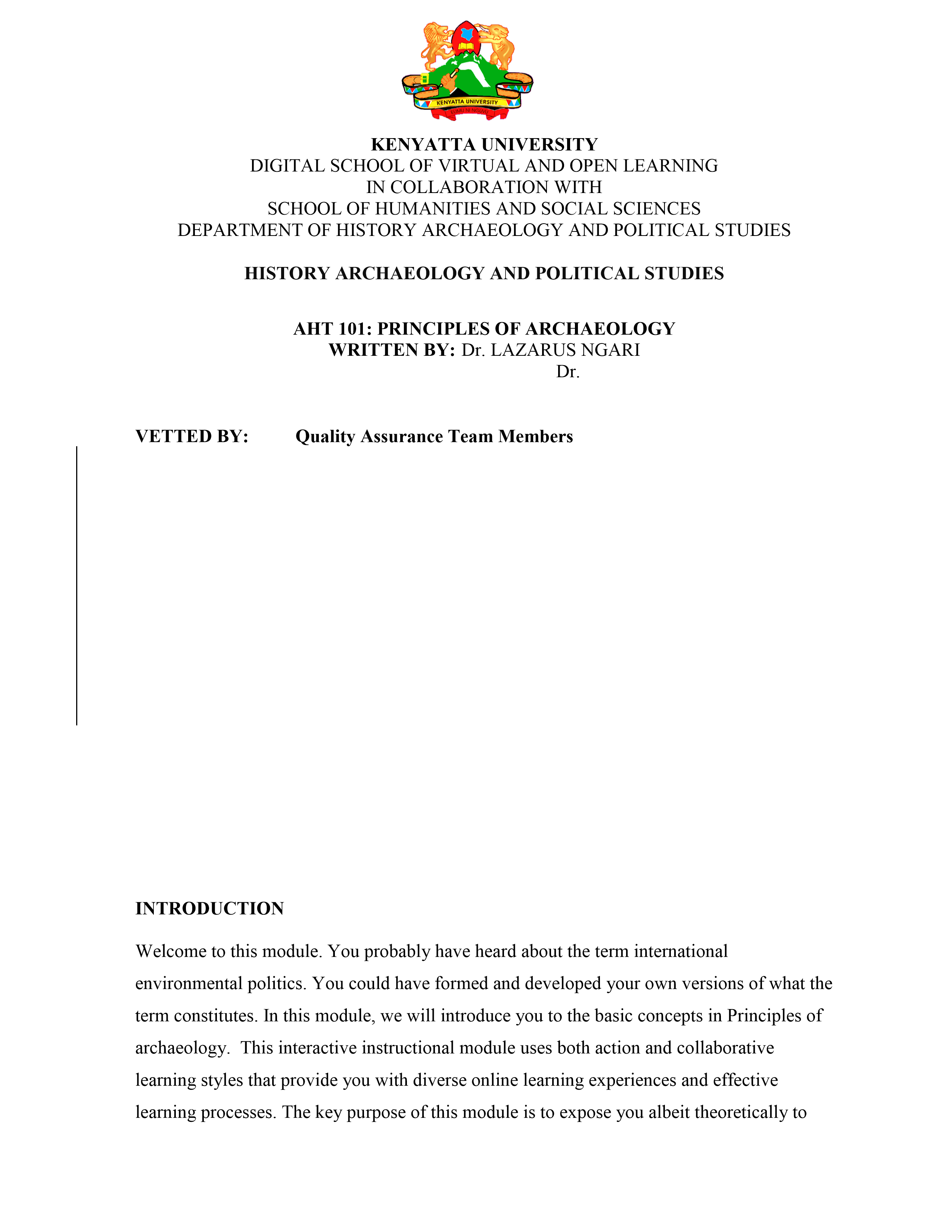
AHT 101: PRINCIPLES OF ARCHAEOLOGY FULL NOTES
| Institution | KENYATTA UNIVERSITY |
| Course | ARCHAEOLOGY AND POLI... |
| Year | 1st Year |
| Semester | Unknown |
| Posted By | Mwalimu Evans Okoyo. |
| File Type | |
| Pages | 69 Pages |
| File Size | 1.49 MB |
| Views | 6773 |
| Downloads | 1 |
| Price: |
Buy Now
 Buy via
whatsapp Buy via
whatsapp
|


Description
The key purpose of this module is to expose you albeit theoretically tothe various areas in Principles of archaeology that there are and how they have been used to
interrogate archaeological findings. This should hopefully equip you with the necessary attitudes, knowledge and skills crucial in Principles of archaeology as well as cope with challenges and opportunities that may arise during debates on who was responsible on archaeological issues.
Below is the document preview.

HBC 2101: ACCOUNTING FOR MERCHANDISING OPERATIONS
Trending!
Income Statements
Single-step income statement
Multiple-step income statement
Gross Margin = Gross Profit = Net Sales – Cost of Goods Sold
Gross Margin ratio = Gross Margin / Net Sales
25 Pages
7219 Views
0 Downloads
62.17 KB
HBC 2101: Accounting Principles Second Canadian Edition
Trending!
A merchandising company is an enterprise that buys and sells goods to earn a profit.
1. Wholesalers sell to retailers.
2. Retailers sell to consumers.
25 Pages
5861 Views
0 Downloads
265.27 KB
HBC 2101: Accounting Basics
Trending!
In accounting, there are two types of accounts: debit accounts and credit accounts. Under normal accounting circumstances, debit accounts have a positive balance and credit accounts have a negative balance. Along these same lines, each accounting transaction requires two entries: A debit entry and a credit entry. This is called double entry accounting.
2 Pages
7378 Views
0 Downloads
63.1 KB
CILS 2101: COMMUNICATION AND INFORMATION LITERACY SKILLS - full notes
Trending!
Welcome to Communication Skills! All human relations, be it formal or
non-formal, official or unofficial are created, developed and sustained through com-
munication. As such it is not only important to carry out communication as a means
to facilitating these relationships but to acquire it as an essential skill of life. This
basically underlines the necessity of the study of this unit as a whole.
159 Pages
7398 Views
0 Downloads
3.55 MB
COMS 110: COMMUNICATION SKILLS 1
Trending!
In this note, we shall examine the field of communication to serve as a foundation to what follows in the course. Principally, we shall define communication; outline its elements, principles and its importance in academic and life in general. We shall also briefly examine the various types of communication.
39 Pages
6415 Views
0 Downloads
724.03 KB
HRD 2101: LESSON 1 Introduction to Communication Skills
Trending!
Welcome to Communication Skills! All human relations, be it formal or non-formal, official or unofficial are created, developed and sustained through communication. As such it is not only important to carry out communication as a means to
facilitating these relationships but to acquire it as an essential skill of life.
56 Pages
7404 Views
1 Downloads
477.39 KB
HRD 2101: LESSON 2 Verbal Communication
Trending!
There are two forms of communication, namely verbal and non-verbal. Communication
by the spoken or written word, as we all may have noticed in our lives, is the most familiar and consciously acclaimed type of communication.
68 Pages
6019 Views
0 Downloads
1.5 MB
HRD 2101: LESSON 3 Patterns and Techniques in Communication
Trending!
The flow of information in an organisation is governed by its structure. In simple terms, organisational structure refers to the manner in which staff are arranged into departments and/or sections that handle different yet correlated tasks in the organisation.
24 Pages
6613 Views
0 Downloads
289.22 KB
HRD 2101: LESSON 4 Techniques in Communication
Trending!
Hearing- reception of sound. Sound strikes the eardrum causing vibrations. Passive activity. Listening- Hearing and interpreting sounds with an aim to understand the meaning behind the sounds. Active activity.
24 Pages
6262 Views
0 Downloads
293.16 KB