ALT 102: INTRODUCTION TO EAST AFRICAN ORAL LITERATURE
| Institution | KENYATTA UNIVERSITY |
| Course | BACHELOR OF ARTS |
| Year | 2nd Year |
| Semester | Unknown |
| Posted By | stephen oyake rabilo |
| File Type | |
| Pages | 160 Pages |
| File Size | 1.52 MB |
| Views | 9797 |
| Downloads | 2 |
| Price: |
Buy Now
 Buy via
whatsapp Buy via
whatsapp
|


Description
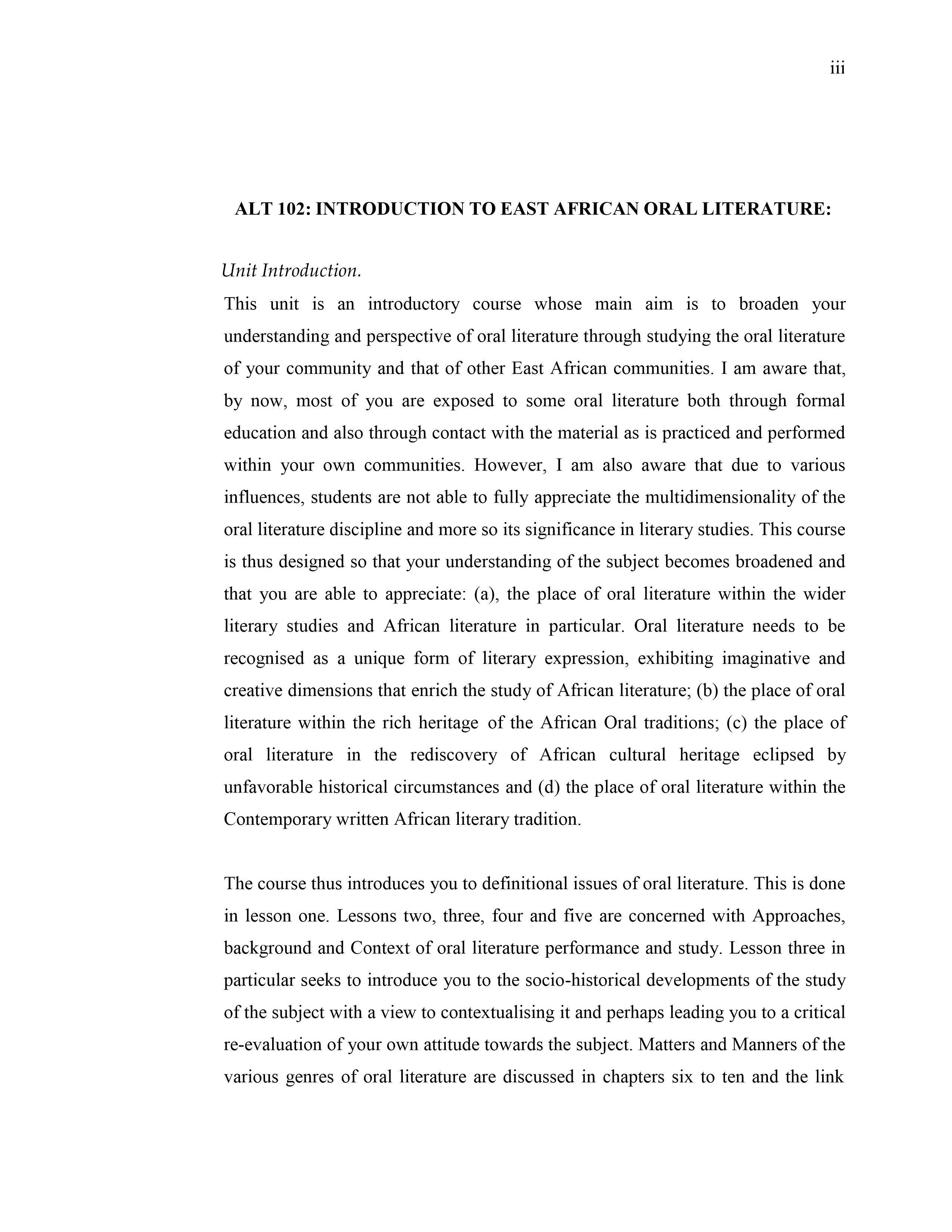
This unit is an introductory course whose main aim is to broaden your
understanding and perspective of oral literature through studying the oral literature
of your community and that of other East African communities. I am aware that,
by now, most of you are exposed to some oral literature both through formal
education and also through contact with the material as is practiced and performed
within your own communities. However, I am also aware that due to various
influences, students are not able to fully appreciate the multidimensionality of the
oral literature discipline and more so its significance in literary studies. This course
is thus designed so that your understanding of the subject becomes broadened and
that you are able to appreciate: (a), the place of oral literature within the wider
literary studies and African literature in particular. Oral literature needs to be
recognised as a unique form of literary expression, exhibiting imaginative and
creative dimensions that enrich the study of African literature; (b) the place of oral
literature within the rich heritage of the African Oral traditions; (c) the place of
oral literature in the rediscovery of African cultural heritage eclipsed by
unfavorable historical circumstances and (d) the place of oral literature within the
Contemporary written African literary tradition
Below is the document preview.

FORMATION OF SCIENTIFIC NAMES
Trending!
Names of plants may be formed in a number of ways;
1. Commemorative ; names may commemorate important persons; those have had major contributions in the science of plants
(Botany).
2. Plants may be named after geographical place or feature
3. Names may come from myths
4. Names be as a result of some character a plant
5. Names may describe the habitat
6. Names may also denote resemblance to another
7. Some plant names are derived from culture
10 Pages
6612 Views
0 Downloads
318.88 KB
KAPSABET HIGH SCHOOL POST-MOCK 2024; C.R.E PP1 & PP2 Q&A
Trending!
Download a copy of the KAPSABET HIGH SCHOOL POST-MOCK 2024; C.R.E PP1 & PP2 Question Papers with well coordinated Marking Schemes attached. This is a good revision material for your upcoming exams.
15 Pages
9309 Views
1 Downloads
1.59 MB
KAPSABET HIGH SCHOOL POST-MOCK 2024; History PP1 & PP2 Q&A
Trending!
Download a copy of the KAPSABET HIGH SCHOOL POST-MOCK 2024; History PP1 & PP2 Question Papers with well coordinated Marking Schemes attached. This is a good revision material for your upcoming exams.
20 Pages
8908 Views
0 Downloads
1.33 MB
KAPSABET HIGH SCHOOL POST-MOCK 2024; Geography PP1 & PP2 Q&A
Trending!
Download a copy of the KAPSABET HIGH SCHOOL POST-MOCK 2024; Geography PP1 & PP2 Question Papers with well coordinated Marking Schemes attached. This is a good revision material for your upcoming exams.
29 Pages
7785 Views
2 Downloads
3 MB
KAPSABET HIGH SCHOOL POST-MOCK 2024; Agriculture PP1 & PP2 Q&A
Trending!
Download a copy of the KAPSABET HIGH SCHOOL POST-MOCK 2024; Agriculture PP1 & PP2 Question Papers with well coordinated Marking Schemes attached. This is a good revision material for your upcoming exams.
30 Pages
7579 Views
0 Downloads
2.14 MB
SEVENTH DAY ADVENTIST MISSION FOR QUARTER 4
Trending!
This quarter we feature the North
American Division, which oversees the
Seventh-day Adventist Church’s work
in the United States, Canada, the French
possessions of St. Pierre and Miquelon, the
British overseas territory of Bermuda, the
U.S. territories of Guam, Wake Island, and
Northern Mariana Islands in the Pacific
Ocean, and three nearby states in free
association with the United States— Palau,
the Marshall Islands, and the Federated
States of Micronesia. The region is home
to 372 million people, including 1,224,769
Adventists. That’s a ratio of one Adventist for
every 304 people
32 Pages
7788 Views
0 Downloads
17.83 MB
MARANDA HIGH JULY MOCK 2024; Biology PP1,PP2 & PP3 Q&A
Trending!
Download a copy of the MARANDA HIGH JULY MOCK 2024; Biology PP1,PP2 & PP3 Question Papers with well coordinated Marking Schemes attached. This is a good revision material for your upcoming exams.
64 Pages
7802 Views
1 Downloads
13.3 MB
CBC PP1 END YEAR ASSESSMENT EXAMS-ALL SUBJECTS
Trending!
Download a copy of the End Year Assessment test for CBC PP1, It comprises of all the subjects; CRE ACTIVITY, ENVIROMENTAL ACTIVITY, IRE ACTIVITY,MATHEMATICS ACTIVITY,LITERACY ACTIVITY,LANGUAGE ACTIVITY, CREATIVE & PSHYCOMOTOR ACTIVITIES.
26 Pages
7672 Views
7 Downloads
2.41 MB
CBC PP2 END YEAR ASSESSMENT EXAMS-ALL SUBJECTS
Trending!
Download a copy of the End Year Assessment test for CBC PP1, It comprises of all the subjects; KISWAHILI ACTIVITY, CRE ACTIVITY, ENVIROMENTAL ACTIVITY, IRE ACTIVITY,MATHEMATICS ACTIVITY,LITERACY ACTIVITY,LANGUAGE ACTIVITY, CREATIVE & PSHYCOMOTOR ACTIVITIES.
34 Pages
8129 Views
1 Downloads
2.83 MB
KISWAHILI FORM 2 TERM 3 END YEAR FULL EXAMS WITH MARKING SCHEMES
Trending!
Get a copy of the KISWAHILI FORM 2 TERM 3 END YEAR FULL EXAMS WITH MARKING SCHEMES. This is a well set and moderated exam paper with a well coordinated comprehensive marking scheme attached herein. Attached is also the EDITABLE Question Papers that you can customize to your preference.
16 Pages
9581 Views
1 Downloads
796.54 KB