COMMUNITY HEALTH I
| Institution | COLLEGE |
| Course | COMMUNITY HEALTH AND... |
| Year | 1st Year |
| Semester | Unknown |
| Posted By | Liz Ochola |
| File Type | |
| Pages | 96 Pages |
| File Size | 2.05 MB |
| Views | 399 |
| Downloads | 0 |
| Price: |
Buy Now
 Buy via
whatsapp Buy via
whatsapp
|


Description
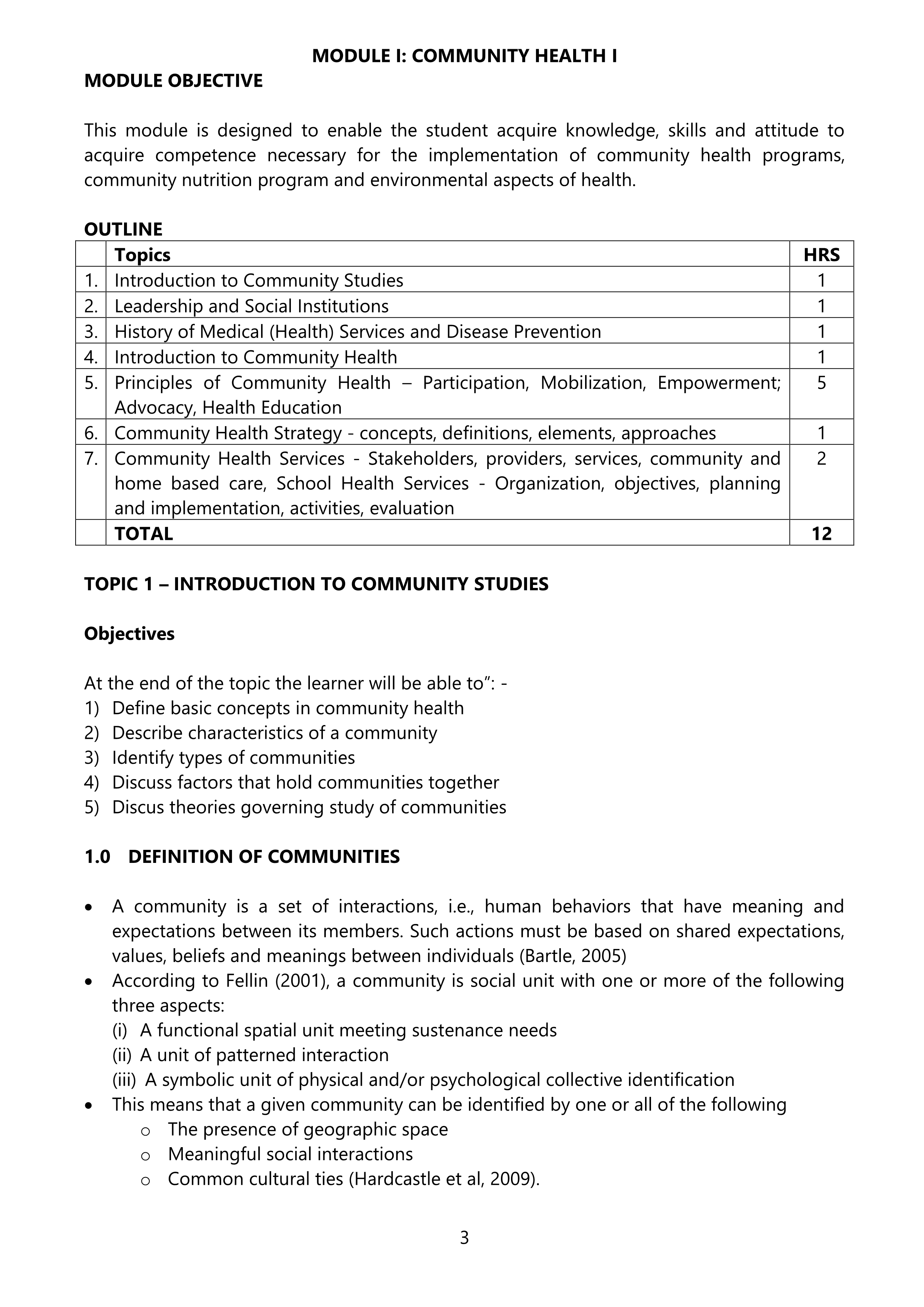
This module is designed to enable the student acquire knowledge, skills and attitude to
acquire competence necessary for the implementation of community health programs,
community nutrition program and environmental aspects of health.
Below is the document preview.

COMMUNITY HEALTH I
Science of food, the nutrients and other substances therein, their action, interaction,
and their balance in relation to health and disease and the process by which the
organism ingests, digests, absorbs, transports, utilizes and excretes food substances.
In simple terms, nutrition is the science of nourishing the body properly or the analysis
of the effects of food on the living organisms.
69 Pages
332 Views
0 Downloads
940.42 KB
COMMUNITY HEALTH III
Community Diagnosis (community or needs assessment) is the foundation for improving and promoting the health of community members. The role of community assessment is to identify factors that affect the health of a population and determine the availability of resources within the community to adequately address these factors.
14 Pages
443 Views
0 Downloads
365.74 KB
COMMUNITY HEALTH I: NUTRITION
Trending!
Community nutrition is an applied field of study that consists of applying a specific body of subject matter to the identification and solution of health and nutritional problems during the interactions of nutrition personnel and the community.
67 Pages
6367 Views
0 Downloads
2.7 MB
COMMUNITY HEALTH III
This is the original data collected for a specific purpose
by or for an investigator. For example, an
epidemiologist may collect primary data by
interviewing people who became ill after eating at a
restaurant in order to identify which specific foods were
consumed.
Collecting primary data is expensive and time consuming, and it usually is undertaken only when
secondary data is not available
67 Pages
489 Views
1 Downloads
1.52 MB
COMMUNITY HEALTH III
Principles of epidemiology: Definitions of terms, purpose of epidemiology, differences
between epidemiological and clinical focus, sources of epidemiological information, mortality and morbidity statistics, epidemiological concepts, epidemiological studies.
2. Communicable diseases: Definition, standard case definition, classification, principles in management, prevention and control, notification and reporting of emerging and re-emerging infections, infestations, specific communicable diseases.
431 Pages
590 Views
1 Downloads
3.75 MB
TVET/CDACC: COMMUNITY HEALTH INFORMATION SYSTEM
Trending!
UNIT OBJECTIVES; Prepare for CHIS performance assessment, Carry out CHIS performance assessment, Utilize community health information system, Establish master community unit list.
19 Pages
2913 Views
1 Downloads
332.88 KB
KMTC Community Health II Nutrition Notes
Trending!
The document provides an overview of community nutrition, emphasizing its principles and the importance of improving health and well-being through effective food systems and nutritional education. It covers key concepts such as nutrition definitions, types of nutrients, food classification, nutritional disorders, and the causes and types of malnutrition. Additionally, it highlights frameworks for understanding malnutrition's multifaceted causes and suggests approaches for prevention and improvement.
33 Pages
3198 Views
0 Downloads
403 KB
HE/OS/CH/CR/03/5/A COMMUNITY HEALTH INFORMATION SYSTEM LEVEL 5
Institution:
Year: 2025/2026
Semester: 1st Year, 2nd Semester (1.2)