BUSINESS LAW
| Institution | UNIVERSITY |
| Course | BUSINESS LAW |
| Year | 1st Year |
| Semester | Unknown |
| Posted By | Liz Ochola |
| File Type | |
| Pages | 70 Pages |
| File Size | 1.23 MB |
| Views | 669 |
| Downloads | 0 |
| Price: |
Buy Now
 Buy via
whatsapp Buy via
whatsapp
|


Description
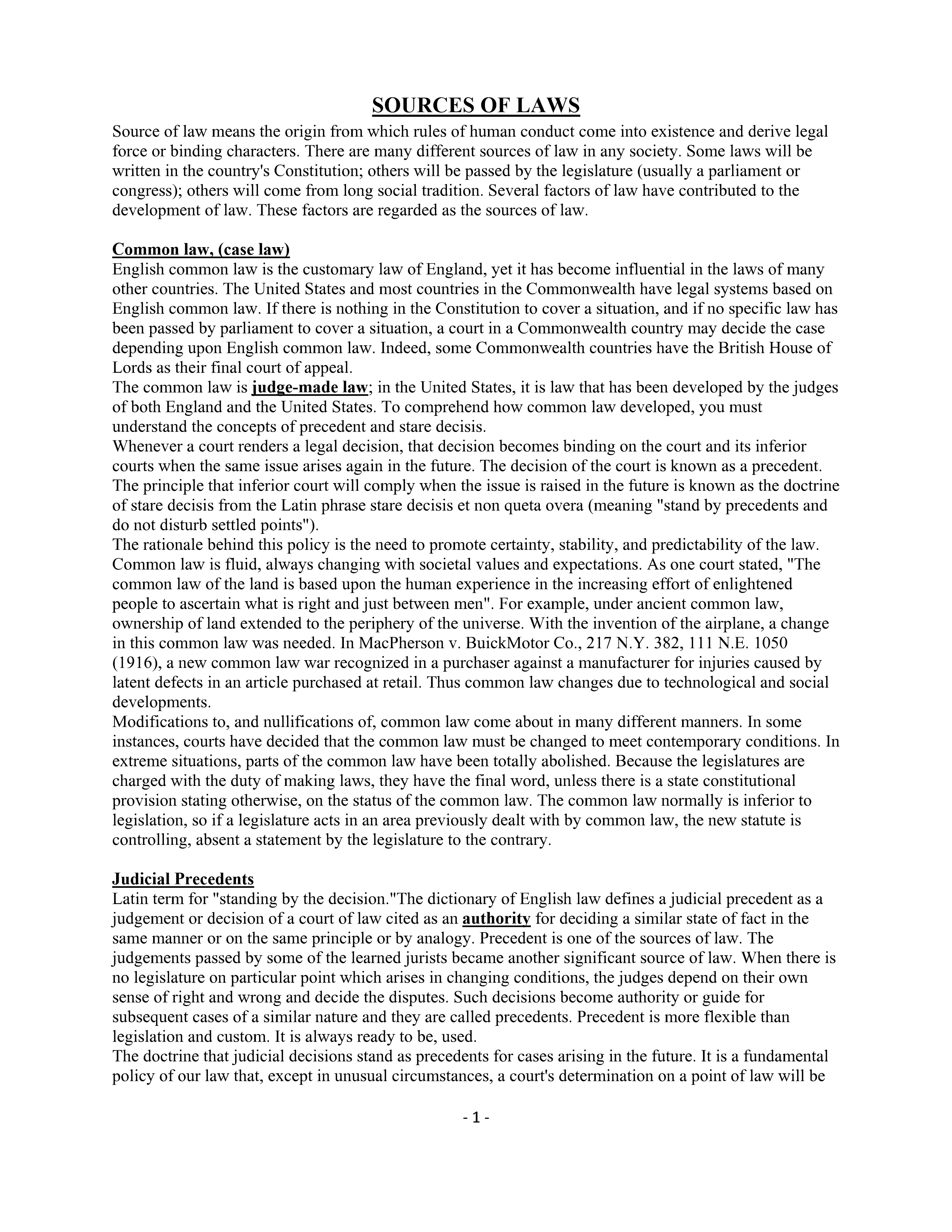
Source of law means the origin from which rules of human conduct come into existence and derive legal force or binding characters. There are many different sources of law in any society. Some laws will be written in the country's Constitution; others will be passed by the legislature (usually a parliament or congress); others will come from long social tradition. Several factors of law have contributed to the
development of law.
Below is the document preview.

Business law revision Q&A
Trending!
The purpose of this business law revision Q and A is to help the student in preparing for the business law law exam
83 Pages
8518 Views
0 Downloads
1.15 MB
LECTURE NOTES FOR BUSINESS LAWS
Trending!
Woodrow Wilson has defined law as “that portion of the established habit and thought of mankind which has gained distinct and formal recognition in the shape of uniform rules backed by the authority and power of the government.”
68 Pages
9325 Views
0 Downloads
725 KB
BUSINESS LAW UPDATED NOTES
Trending!
Covers
Introduction to the nature purpose and kinds of law
The law of torts.
The laws of person's.
Contract of employment.
The law of Contract.
Law of agency.
Sales of goods act.
Hire purchase.
Negotiateable instruments.
4500 Views
0 Downloads
611.06 KB
PASTOR BUSINESS LAW-2015-2021
Get ahead of other by downloading business law past papers for your revision purposes .
24 Pages
997 Views
0 Downloads
4.01 MB
BHM 307: BUSINESS LAW
The primary aim of this course is to familiarize the student with the
subject matter which is dealt with herein and which the student is
expected to know much about at the end of reading through.
164 Pages
451 Views
0 Downloads
780.65 KB
BBA 101: BUSINESS LAW 1 LECTURE NOTES
Trending!
This document provides an overview of Business Law 101 at a university. It discusses four lectures that will be covered: 1) the basic concepts of business law including the definition, nature, and functions of law, as well as why society needs law and how it applies to business; 2) the administrative structure of Kenyan courts and how they help solve business problems; 3) the law of contracts including elements, capacity, remedies, and discharge; and 4) the law of torts including general tort law, defenses, capacity, vicarious liability, and actions relating to trespass to person, land, and goods. The lectures include questions to help with student revision. An appendix also provides guidance on answering law questions.
99 Pages
4426 Views
2 Downloads
503.56 KB
Business law
Business law is made up of the laws that set out the rights, duties and obligations of
people in business. Business law balances the interests of those in business and people like
producers and consumers, buyers and sellers, lenders and borrowers. It regulates business
transactions under the law of contract, which explains when an agreement will be legally
enforceable as a contract and is updated by competition and consumer law. It regulates
those engaged in business (companies, partnerships, etc), their names, their funding
(finance, credit), their banking and their insurance. Many aspects of criminal law (especially
property offences) and tort (especially the law of negligence) impact on business.
154 Pages
695 Views
0 Downloads
4.86 MB
BUSINESS LAW DBM1311
Trending!
This is a first-year Diploma course in business course which gives the students exposure to the legal principles
that bind transactions that business people engage in. The course first explores the nature of Law and introduces
the student to the Kenyan legal system. Further, the course explores diverse areas of law that relate to the
activities that business people engage in daily. These include the law of torts, the law of contract, the law of
agency, the law of employment, and the sale of goods law The course is divided into two parts: Business Law 1
and Business Law 2. Business Law 1 is offered in the first semester and business law 2 is provided in the
second trimester of study.
Course objectives
By the end of the course unit, the students should be able to: -
a) Appreciate the legal context in which business law applies.
b) Comprehend but simplify the account of rules relating to the formation, content, and enforcement of
contracts.
c) Illustrate how the law applies to business content.
d) Appreciate the significance of business law and its contribution to the development and success of business.
Course instruction will be through lectures, tutorials, group discussions, and individual assignments.
Attendance and participation in lectures, tutorials, and group discussions is required. Through this, the student
will understand the legal concepts.
The course will be assessed as per the university examinations regulations where the continuous assessment
tests carry 30 marks and the final exam carry 70 marks
169 Pages
2081 Views
0 Downloads
1.01 MB