C e r e b r a l P a l s y
| Institution | UNIVERSITY |
| Course | MEDICINE |
| Year | 1st Year |
| Semester | Unknown |
| Posted By | Brian Mike |
| File Type | |
| Pages | 39 Pages |
| File Size | 896.7 KB |
| Views | 8090 |
| Downloads | 0 |
| Price: |
Buy Now
 Buy via
whatsapp Buy via
whatsapp
|


Description
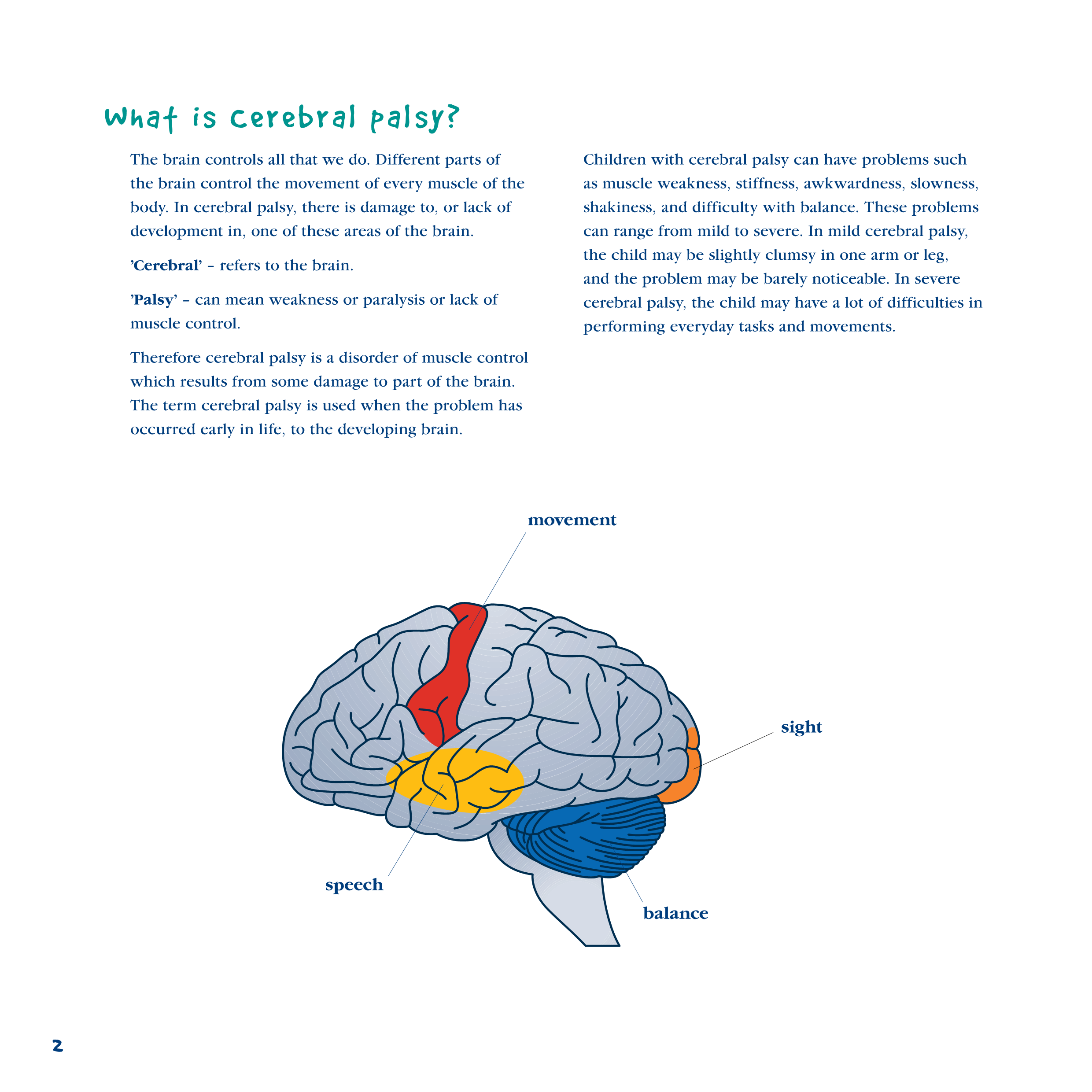
The brain controls all that we do. Different parts of
the brain control the movement of every muscle of the
body. In cerebral palsy, there is damage to, or lack of
development in, one of these areas of the brain.
'Cerebral' – refers to the brain. 'Palsy' – can mean weakness or paralysis or lack of muscle control. Therefore cerebral palsy is a disorder of muscle control which results from some damage to part of the brain. The term cerebral palsy is used when the problem has occurred early in life, to the developing brain.
Below is the document preview.

Lab Report Format
Trending!
Theory/Introduction: This step should introduce the experiment. Include background
information relevant to the experiment, important definitions, theoretical and historical
background, and general methods that are going to be used.
7 Pages
8698 Views
0 Downloads
674.79 KB
GEOGRAPHY SYLLABUS F1 TO F4 COMBINED
Trending!
The purpose of this geography syllabus form 1 to form 4 combined is to equip the student with knowledge and skills to study and revise well to save time
10 Pages
11232 Views
10 Downloads
59.27 KB
GEOGRAPHY FORM 4 NOTES
Trending!
The purpose of this geography notes is to equip the student with knowledge and skills to enable him or her understand this subject better
No pages found
8933 Views
3 Downloads
5.44 MB
AMS 308 Lecture 1: INTRODUCTION TO ANAYLYSIS OF EXPERIMENTS
Trending!
Observing a system or process while it is in operation is an important part of the
learning process, and is an integral part of understanding and learning about how
systems and processes work.
11 Pages
8097 Views
2 Downloads
441.8 KB
AMS 308 Lecture 2: SIMPLE COMPARATIVE EXPERIMENTS
Trending!
Hypothesis testing allows the comparison of the two formulations to be made on
objective terms, with knowledge of the risks associated with reaching the wrong
conclusion.
9 Pages
7127 Views
2 Downloads
791.97 KB
AMS 308 Lecture 3: EXPERIMENTS WITH A SINGLE FACTOR
Trending!
In such a single factor experiment with a completely randomized design, the
levels of the factor are randomly assigned to the experimental units in some cases,
randomly selecting experimental units from each level of the factor.
28 Pages
7865 Views
1 Downloads
1.88 MB
AMS 308 Lecture 4: THE RANDOMIZED COMPLETE BLOCK DESIGN
Trending!
In any experiment, variability arising from a nuisance factor can affect the results.
Generally, we define a nuisance factor as a design factor that probably has an effect
on the response, but we are not interested in that effect.
8 Pages
8238 Views
1 Downloads
644.64 KB
AMS 308 Lecture 5: THE LATIN SQUARE DESIGN
Trending!
Suppose that an experimenter is studying the effects of five different formulations of
a rocket propellant used in aircrew escape systems on the observed burning rate.
Each formulation is mixed from a batch of raw material that is only large enough for
five formulations to be tested.
6 Pages
7378 Views
2 Downloads
690.8 KB
AMS 309 Lecture 1: Probability Generating Functions
Trending!
A mathematical model which specifies complete probability distribution of the number of individuals in a given system at each point of time is a stochastic model.
9 Pages
9921 Views
3 Downloads
452.97 KB
AMS 309 Lecture 2: Discrete Branching Process
Trending!
Suppose that one particle can produce a random number of k new particles. Each of the
new particles produces another random number of new particles. We assume that the
particles act independently of each other and that every particle has a probability pk of
producing k new particles (for k = 0, 1, 2, , . . ).
7 Pages
9184 Views
2 Downloads
408.88 KB