MALARIA
| Institution | KMTC |
| Course | CLINICAL MEDICINE |
| Year | 1st Year |
| Semester | Unknown |
| Posted By | Mwalimu Evans Okoyo. |
| File Type | |
| Pages | 5 Pages |
| File Size | 313.09 KB |
| Views | 1615 |
| Downloads | 0 |
| Price: |
Buy Now
 Buy via
whatsapp Buy via
whatsapp
|


Description
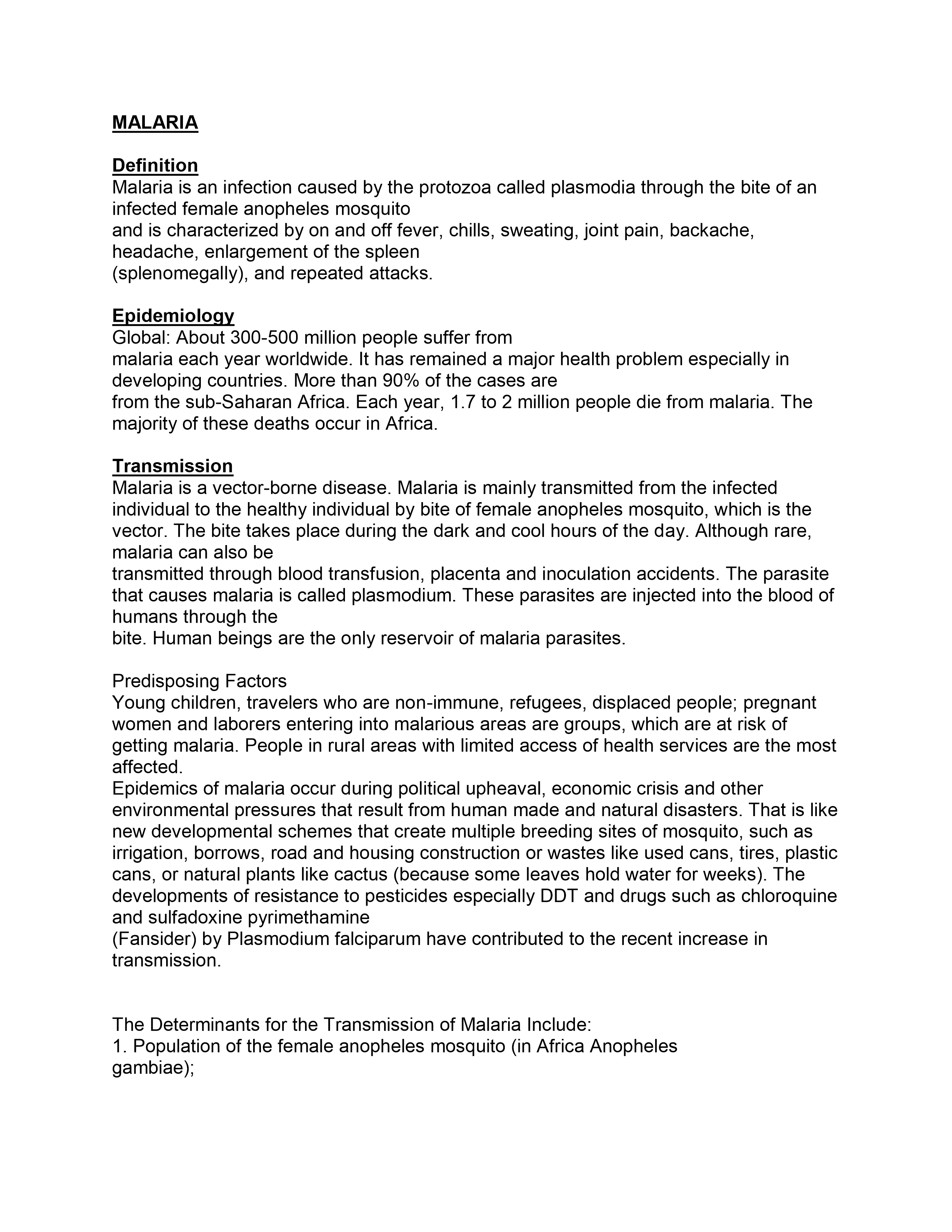
Malaria is an infection caused by the protozoa called plasmodia through the bite of an infected female anopheles mosquito and is characterized by on and off fever, chills, sweating, joint pain, backache, headache, enlargement of the spleen (splenomegally), and repeated attacks.
Below is the document preview.

FACTORS CONTRIBUTING TO HIGH PREVAILENCE OF MALARIA AMONG CHILDREN UNDER-FIVE YEARSATTENDING KISUMU DISTRICT HOSPITAL
Malaria is a life-threatening disease that has adverse effects on child development. The effects include absenteeism from school and pains associated with malaria. Malaria is an urgent public health priority and has resulted families in a cycle of illness, suffering and poverty. The study described the existing relationship, between socio-demographic characteristics of caregivers; household’s socioeconomic factors; maternal healthcare and immunization against childhood disease and health status of children under-five years. The general objective was to determine risk factors associated with occurrence of malaria among children attending Kisumu district hospital in Kisumu county. The specific objectives were to determine the socio-economic, demographic and environmental factors associated with occurrence of malaria among children attending Kisumu hospital. The sample size of this study was 248 household with children under-five years based on the target population of 681 elements in Kisumu county. The study used both primary and secondary data for study. Primary data was collected using questionnaires and secondary data derived from Kenya Malaria Indicator Survey (KMIS) conducted in 2017.Data was analyzed using tables, mean and percentage by use of Statistical Package for Social Sciences (SPSS) version 17. The response rate was high for male gender representing 62.1% and female 37.9%. The study also revealed that age, place of residence, level of anemia, wealth quintile, availability of electricity and cluster altitude were significant predictors of malaria. The study revealed that aspects such as source of household food, number of meals taken during food shortage, main source of drinking water, where healthcare is sought and ownership of agricultural land are not statistically significant. From findings we concluded that gender of the household head has an influence on the health status of children under-five years. Furthermore, level of education and occupation of the caregiver had an influence on health status of children under-five years. The study recommends that greater efforts need to be put in place by the government to ensure provision of affordable water, nutrition education, provision of employment and proper healthcare to fight the under five mortality
44 Pages
655 Views
0 Downloads
377.66 KB
FACTORS CONTRIBUTING TO HIGH PREVAILENCE OF MALARIA AMONG CHILDREN UNDER-FIVE YEARSATTENDING KISUMU DISTRICT HOSPITAL-Diploma in pharmaceutical technology
Trending!
Diploma in pharmaceutical technology
Malaria is a life-threatening disease that has adverse effects on child development. The effects include absenteeism from school and pains associated with malaria. Malaria is an urgent public health priority and has resulted families in a cycle of illness, suffering and poverty. The study described the existing relationship, between socio-demographic characteristics of caregivers; household’s socioeconomic factors; maternal healthcare and immunization against childhood disease and health status of children under-five years. The general objective was to determine risk factors associated with occurrence of malaria among children attending Kisumu district hospital in Kisumu county. The specific objectives were to determine the socio-economic, demographic and environmental factors associated with occurrence of malaria among children attending Kisumu hospital. The sample size of this study was 248 household with children under-five years based on the target population of 681 elements in Kisumu county. The study used both primary and secondary data for study. Primary data was collected using questionnaires and secondary data derived from Kenya Malaria Indicator Survey (KMIS) conducted in 2017.Data was analyzed using tables, mean and percentage by use of Statistical Package for Social Sciences (SPSS) version 17. The response rate was high for male gender representing 62.1% and female 37.9%. The study also revealed that age, place of residence, level of anemia, wealth quintile, availability of electricity and cluster altitude were significant predictors of malaria. The study revealed that aspects such as source of household food, number of meals taken during food shortage, main source of drinking water, where healthcare is sought and ownership of agricultural land are not statistically significant. From findings we concluded that gender of the household head has an influence on the health status of children under-five years. Furthermore, level of education and occupation of the caregiver had an influence on health status of children under-five years. The study recommends that greater efforts need to be put in place by the government to ensure provision of affordable water, nutrition education, provision of employment and proper healthcare to fight the under five mortality
44 Pages
3953 Views
0 Downloads
377.66 KB
ANTI-MALARIAL DRUGS
Trending!
Malaria is transmitted by the bite of infected female anopheles mosquitoes. During feeding, mosquitoes inject sporozoites, which circulate to the liver, and rapidly infect hepatocytes, causing asymptomatic liver infection (hepatic phase)(absent in falciparum; malariae) . Merozoites released from the liver, rapidly infect erythrocytes to begin the asexual erythrocytic stage of infection that is responsible for human disease. Multiple rounds of erythrocytic development, with production of merozoites that invade additional erythrocytes, lead to large numbers of circulating parasites and clinical illness
34 Pages
4220 Views
0 Downloads
561.95 KB