Mathematics
| Institution | Egerton University |
| Course | Mathematics |
| Year | 1st Year |
| Semester | Unknown |
| Posted By | Summy Vladimir |
| File Type | |
| Pages | 16 Pages |
| File Size | 1.46 MB |
| Views | 138 |
| Downloads | 0 |
| Price: |
Buy Now
 Buy via
whatsapp Buy via
whatsapp
|


Description
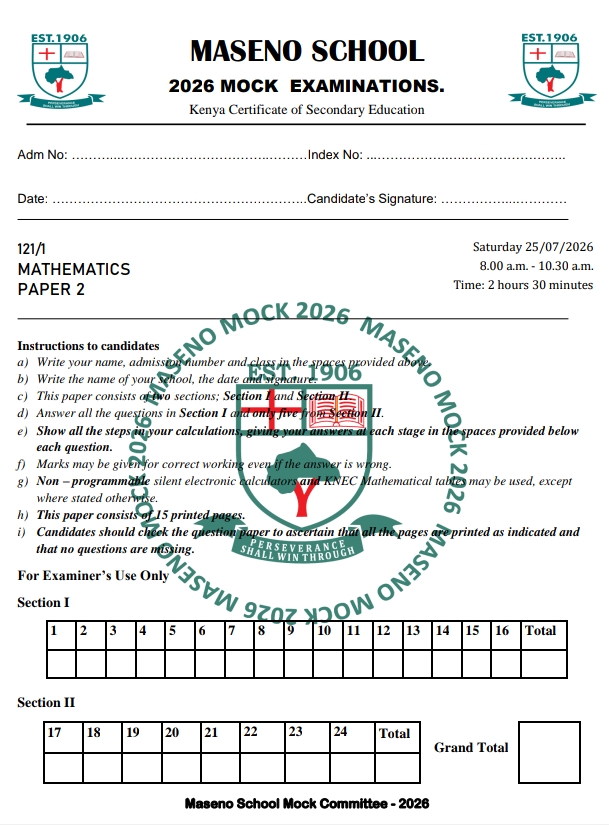
A collection of KCSE Mathematics Paper 2 questions designed to help candidates practise and revise key Paper 2 topics, improve problem-solving skills, and familiarize themselves with the format and difficulty of KCSE 2026-2027
Below is the document preview.

SMA 2104: Mathematics for Sciences - Course Outline
Trending!
This unit aims at providing a good foundation in mathematics for students who plans to do more specialized work in the university, especially in the Computing, Medicine, Engineering, etc.
3 Pages
9350 Views
0 Downloads
266.54 KB
SMA 2104: Mathematics for Sciences - Lesson 1 Quadratic equations
Trending!
Upon completing this topic, you should be able to: Solve quadratic equations by factoring Learning outcomes Solve quadratic equations using the method of extraction of roots Determine the nature of the solutions to a quadratic equation Understand the logic underlying the method of completing Solve a quadratic equation using the method of completing
No pages found
10132 Views
0 Downloads
367.62 KB
SMA 2104: Mathematics for Sciences - Lesson 2 Algebra
Trending!
By the end of this topic you should be able to; Understand the laws of indices and their application in simplifying algebraic expressions. Define index, Establish the laws of indices, Solve simple problems using the laws of indices. Understand the theory of logarithms and surds and their applications in manipulating expressions. Define logarithm
No pages found
9689 Views
0 Downloads
344.76 KB
SMA 2104: Mathematics for Sciences - Lesson 3 Sequences and series
Trending!
Upon completing this topic, you should be able to:
Differentiate between a series and a sequence, Use Sigma notation in representing a series, Understand the properties of arithmetic and geometric progressions, Define an Arithmetic progression (A.P.), Obtain the formula for nth term and the first n terms of an A.P, Define a geometric progression (G.P.)
No pages found
9006 Views
0 Downloads
325.42 KB
SMA 2104: Mathematics for Sciences - Lesson 4 Factorisable polynomials
Trending!
Upon completing this topic, you should be able to factorise and solve polynomials of degree higher than 2
No pages found
9135 Views
0 Downloads
277.4 KB
SMA 2104: Mathematics for Sciences - Lesson 5 Permutations and Combination
Trending!
Permutations and Combination
Permutations - This is defined as the number of different ways of arranging different objects in order.
No pages found
8664 Views
0 Downloads
273.38 KB
SMA 2104: Mathematics for Sciences - Lesson 6 Binomial expansion
Trending!
Upon completing this topic you should be able to understand the binomial theorem and it’s application in the expansion of expressions and in approximations.
No pages found
9313 Views
0 Downloads
282.79 KB
SMA 2104: Mathematics for Sciences - Lesson 7 Probability
Trending!
Upon completing this topic,you should be able to;- Apply the principles of probability to solve problems in real-world contexts. Understand and use the language of probability and to compute the probabilities of composite events using the basic rules of probability.
No pages found
9125 Views
0 Downloads
395.57 KB
SMA 2104: Mathematics for Sciences - Lesson 8 Statistics
Trending!
Upon completing this topic,you should be able to Collect, organize, and represent data, and be able to recognize and describe relationships. Apply the principles of statistics to solve problems in real world contexts. Demonstrate knowledge of statistical terms. Differentiate between the two branches of statistics. Identify types of data. Understand and use the basic measure of central tendency
No pages found
8401 Views
0 Downloads
282.84 KB
SMA 2104: Mathematics for Sciences - Lesson 9 TRIGONOMETRY
Trending!
Upon completing this topic, you should be able to Define, manipulate and apply trigonometric functions. Define the basic trigonometric ratios, sine, cosine and tangent of an angle and derive the other trigonometric ratios; cosecant, secant and cotangent using the basic trigonometric ratios. Derive identities involving the trigonometric ratios
11 Pages
9740 Views
0 Downloads
635.34 KB