SMA 2371: Partial Differential Equations (Complete Notes, Examples & Solutions) – JKUAT Biostatistics Year 2 Semester 2
| Institution | Jomo Kenyatta University of Science and Technology |
| Course | Bsc. biostatistics |
| Year | 2nd Year |
| Semester | Unknown |
| Posted By | Brian |
| File Type | |
| Pages | 57 Pages |
| File Size | 1.77 MB |
| Views | 172 |
| Downloads | 0 |
| Price: |
Buy Now
 Buy via
whatsapp Buy via
whatsapp
|


Description
These are comprehensive and well-organized lecture notes for SMA 2371: Partial Differential Equations (PDE) offered to BSc. Biostatistics Year 2 Semester 2 students at JKUAT. The notes are neatly arranged from lecture one to the final topics, making them ideal for class learning, revision, CAT preparation, and final examinations.
The notes include detailed explanations, worked examples, step-by-step mathematical derivations, solved exercises, and applications of Partial Differential Equations. Topics covered include:
• Review of basic concepts and partial derivatives
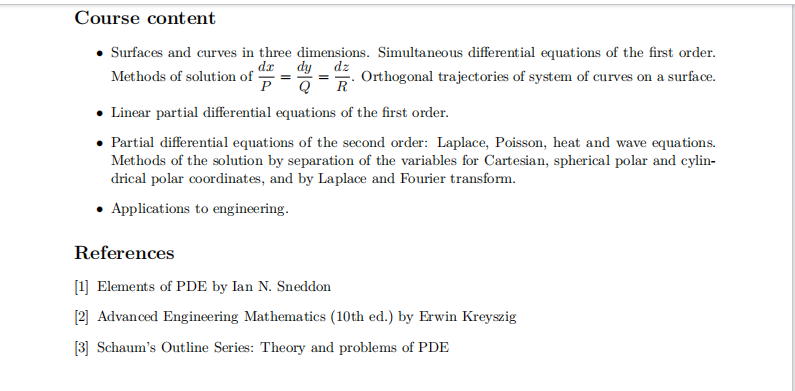
• Jacobians, surfaces and curves in three dimensions
• Simultaneous first-order differential equations
• Methods of solving symmetric differential equations
• Orthogonal trajectories
• Pfaffian differential equations
• Linear first-order partial differential equations
• Formation of PDEs
• Elimination of arbitrary constants and arbitrary functions
• Heat, Wave, Laplace and Poisson equations
• Separation of variables
• Fourier and Laplace Transform methods
• Numerous worked examples, tutorial questions and examination-style problems with solutions.
These notes are suitable for JKUAT students and other university students studying Mathematics, Statistics, Biostatistics, Engineering, Applied Mathematics or related courses. They are an excellent revision resource for CATs and final examinations.
Below is the document preview.

Introduction to cloud computing
Trending!
Cloud computing refers to the delivery of computing services over the internet ("the cloud"). These services include servers, storage, databases, networking, software, analytics, and more. Instead of owning physical data centers or servers, businesses and individuals can access technology resources on-demand from a cloud service provider.
3448 Views
0 Downloads
2.21 MB
Building cloud infrastructure
Trending!
Building cloud infrastructure involves creating and deploying a combination of hardware, software, networking, and services to host and manage applications, data, and resources in a cloud computing environment.
3286 Views
0 Downloads
1.32 MB
Physical layer
Trending!
In cloud computing, the physical layer refers to the foundational hardware infrastructure and resources that support the cloud environment. It includes all the physical components necessary to store, process, and transmit data.
3411 Views
0 Downloads
3.48 MB
Virtual Layer
Trending!
A virtual layer refers to an abstraction layer that separates the physical resources or systems from the applications or processes that utilize them. It creates an interface or "virtualization" to make underlying resources more flexible, scalable, and easier to manage. Virtual layers are commonly used in computing, networking, and software environments.
3242 Views
0 Downloads
1.82 MB
Control Layer
Trending!
control layer refers to the management and orchestration layer that oversees the underlying cloud infrastructure. It acts as an intermediary between the physical or virtual resources and the user or application interfaces. The control layer is responsible for enabling resource provisioning, monitoring, scaling, and other management tasks.
3463 Views
0 Downloads
1.5 MB
Service and Orchestration
Trending!
A service in cloud computing refers to a specific resource or functionality provided by a cloud provider. Services can range from infrastructure to platforms and applications.Service orchestration is the automated coordination and management of multiple services to achieve a specific outcome. It ensures that individual services work together efficiently to deliver complex workflows or applications.
3457 Views
0 Downloads
2.1 MB
Business Continuity
Trending!
Business continuity refers to the ability of a business or organization to maintain essential functions during and after a disruptive event. In the context of cloud computing, it ensures that cloud-based services and applications remain available and operational, even in the event of hardware failures, cyberattacks, natural disasters, or other emergencies. Business continuity in cloud computing focuses on resilience, redundancy, and minimizing downtime.
3365 Views
0 Downloads
4.71 MB
Security
This module focuses security cross-layer function of the cloud computing reference model. This module focuses on key security threats to a cloud infrastructure. It focuses on the various security mechanisms that enables the cloud service providers to mitigate these threats. Finally, this module focuses on the governance, risk, and compliance (GRC) aspect in a cloud environment.
935 Views
0 Downloads
1.91 MB
Service Management
This module focuses on the service management cross-layer function of the cloud computing reference model. This module focuses on service portfolio management and service operation management processes.
541 Views
0 Downloads
1.46 MB
Introduction to advanced database
Trending!
An Introduction to Advanced Databases typically covers a range of advanced topics related to the design, management, and optimization of large and complex database systems. The focus is often on systems that go beyond basic relational databases, delving into areas that involve performance optimization, data integrity, distributed systems, and advanced querying techniques.
3829 Views
0 Downloads
789.5 KB