SMA 2371: Partial Differential Equations (Complete Notes, Examples & Solutions) – JKUAT Biostatistics Year 2 Semester 2
| Institution | Jomo Kenyatta University of Science and Technology |
| Course | Bsc. biostatistics |
| Year | 2nd Year |
| Semester | Unknown |
| Posted By | Brian |
| File Type | |
| Pages | 57 Pages |
| File Size | 1.77 MB |
| Views | 177 |
| Downloads | 0 |
| Price: |
Buy Now
 Buy via
whatsapp Buy via
whatsapp
|


Description
These are comprehensive and well-organized lecture notes for SMA 2371: Partial Differential Equations (PDE) offered to BSc. Biostatistics Year 2 Semester 2 students at JKUAT. The notes are neatly arranged from lecture one to the final topics, making them ideal for class learning, revision, CAT preparation, and final examinations.
The notes include detailed explanations, worked examples, step-by-step mathematical derivations, solved exercises, and applications of Partial Differential Equations. Topics covered include:
• Review of basic concepts and partial derivatives
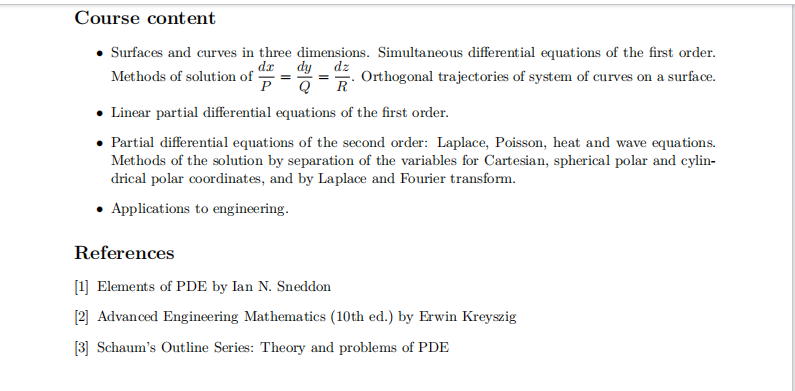
• Jacobians, surfaces and curves in three dimensions
• Simultaneous first-order differential equations
• Methods of solving symmetric differential equations
• Orthogonal trajectories
• Pfaffian differential equations
• Linear first-order partial differential equations
• Formation of PDEs
• Elimination of arbitrary constants and arbitrary functions
• Heat, Wave, Laplace and Poisson equations
• Separation of variables
• Fourier and Laplace Transform methods
• Numerous worked examples, tutorial questions and examination-style problems with solutions.
These notes are suitable for JKUAT students and other university students studying Mathematics, Statistics, Biostatistics, Engineering, Applied Mathematics or related courses. They are an excellent revision resource for CATs and final examinations.
Below is the document preview.

Knowledge Representation
Knowledge representation in Artificial Intelligence (AI) refers to the methods used to encode information about the world in a format that a computer can process and reason with. It enables AI systems to store, retrieve, and manipulate knowledge to make informed decisions. Common techniques include semantic networks, frames, production rules, and ontologies, each suited for different problem domains. Effective knowledge representation allows AI to perform reasoning, understand natural language, and interact intelligently with humans. It is fundamental to expert systems, natural language processing, and automated decision-making, making AI systems more efficient and capable of solving complex problems.
8 Pages
487 Views
0 Downloads
303.99 KB
Techniques of knowledge representation
Trending!
Techniques of knowledge representation in Artificial Intelligence (AI) define how information is structured and processed for reasoning and decision-making. The main techniques include logical representation, which uses formal logic to express facts and rules; semantic networks, which represent knowledge as interconnected nodes and relationships; frames, which organize knowledge into structured templates with attributes and values; and production rules, which use "if-then" statements for decision-making. Ontologies provide a hierarchical structure of concepts and their relationships, enabling AI to understand context. These techniques help AI systems efficiently store, retrieve, and apply knowledge, making them crucial for expert systems, natural language processing, and intelligent decision-making.
7 Pages
3265 Views
0 Downloads
1.11 MB
Propositional Logic in Artificial Intelligence
Trending!
Propositional Logic in Artificial Intelligence (AI) is a formal system used to represent and reason about facts and relationships in a structured and unambiguous way. It consists of propositions, which are statements that can be either true or false, and logical connectives such as AND, OR, NOT, IMPLICATION, and BICONDITIONAL. In AI, propositional logic is used for knowledge representation, automated reasoning, and decision-making. It enables inference through rules of deduction, such as Modus Ponens and Resolution, allowing AI systems to derive new knowledge from existing facts. However, while propositional logic is useful for simple reasoning tasks, it lacks expressiveness for handling complex domains involving variables, quantifiers, or uncertainty, which are addressed by more advanced logical systems like First-Order Logic and Probabilistic Logic.
7 Pages
3773 Views
1 Downloads
214.07 KB
First- order Logic in Artificial Intelligence
Trending!
First-Order Logic (FOL) in Artificial Intelligence (AI) is a formal system used to represent and reason about knowledge. It extends propositional logic variables, predicates, and functions, allowing for more expressive statements about objects and their relationships. FOL enables AI systems to model complex real world scenarios, perform automated reasoning, and derive conclusions based on logical inference. It is widely used in knowledge representation, expert systems, and natural language processing, making it a foundational tool for building intelligent agents.
8 Pages
3599 Views
1 Downloads
227.19 KB
Rules of Inference in Artificial Intelligence
Trending!
Rules of Inference in Artificial Intelligence (AI) are logical principles that enable the derivation of new truths from existing knowledge, ensuring sound reasoning in automated systems. They help AI systems in theorem proving, automated reasoning, and decision-making by systematically deriving conclusions from a given set of premises. Effective use of these inference rules enhances the ability of AI to reason, solve problems, and make logical decisions in knowledge-based systems.
7 Pages
3441 Views
0 Downloads
235.51 KB
Forward Chaining and Backward Chaining in AI
Trending!
Buy "Forward Chaining and Backward Chaining in AI" now and learn more about how inference engines empower intelligent systems to infer new information from known facts. This engaging book takes you on a journey through the logical rules and algorithms that drive artificial intelligence, with detailed examples and practical applications that make complex concepts accessible to both beginners and seasoned professionals.
Discover the fascinating world of forward and backward chaining, essential components in AI that allow systems to reason and make informed decisions. Whether you're interested in the foundations of expert systems, diagnosis, or game theory, this book provides invaluable insights into the reasoning processes that underpin AI applications. Don't miss out on this essential read for anyone looking to deepen their understanding of artificial intelligence.
18 Pages
3866 Views
0 Downloads
467.75 KB
Machine Learning Tutorial
Trending!
Buy Machine Learning Tutorial and learn the essence of machine learning, which empowers computers to autonomously learn from historical data. The book delves into various machine learning techniques, including Supervised, Unsupervised, and Reinforcement learning, offering a comprehensive understanding of regression and classification models, clustering methods, hidden Markov models, and more. It demonstrates the wide-ranging applications of machine learning in today's technology-driven world, from image and speech recognition to email filtering and recommendation systems.
14 Pages
4032 Views
0 Downloads
586.74 KB
Introduction to Artificial Intelligence
Buy "Introduction to AI" now and learn more about the fundamental concepts and applications of artificial intelligence. This insightful book provides a comprehensive overview of AI, covering its history, key technologies, and the latest advancements in the field. With clear explanations and practical examples, the book makes complex AI concepts accessible to beginners and provides valuable insights for seasoned professionals.
Explore the fascinating world of machine learning, neural networks, natural language processing, and more. The book delves into how these technologies are being used to solve real-world problems and transform industries. "Introduction to AI" is an essential read for anyone looking to understand the principles of artificial intelligence and its impact on our lives.
14 Pages
429 Views
0 Downloads
586.74 KB
Natural Language Processing (NLP)
Trending!
Buy "Natural Language Processing (NLP)" now and learn how machines can understand, analyze, manipulate, and interpret human languages. This comprehensive book covers the history, key technologies, and latest advancements in NLP, providing detailed explanations of machine translation, automatic summarization, Named Entity Recognition (NER), speech recognition, relationship extraction, and topic segmentation. Through practical examples and clear narratives, the book makes complex NLP concepts accessible to both beginners and seasoned professionals.
Discover the evolution of NLP from its early days of machine translation to modern applications like speech recognition and chatbots. The book delves into the mechanisms behind NLP technologies, highlighting their advantages and limitations, and exploring real-world applications such as sentiment analysis, spam detection, and information extraction. "Natural Language Processing (NLP)" is an essential read for anyone looking to understand the principles and applications of NLP and its impact on our everyday lives.
7 Pages
3807 Views
0 Downloads
234.92 KB
Probabilistic Reasoning in AI
Trending!
Buy "Probabilistic Reasoning in AI" now and learn how to navigate the uncertainty inherent in real-world scenarios. This insightful book explores the causes of uncertainty, from unreliable sources to equipment faults, and introduces probabilistic reasoning as a robust method for knowledge representation. By integrating probability theory with logic, the book provides a comprehensive approach to handling uncertain knowledge, making it an invaluable resource for both beginners and seasoned professionals in the field of artificial intelligence.
Discover the essential techniques of probabilistic reasoning, such as Bayes' rule and Bayesian statistics, that enable AI systems to make informed decisions despite unpredictable outcomes. The book covers key concepts like prior and posterior probabilities, conditional probability, and random variables, with practical examples that illustrate their applications in various AI-driven tasks. "Probabilistic Reasoning in AI" is an essential read for anyone looking to deepen their understanding of AI's reasoning processes and effectively apply these techniques to solve complex real-world problems.
6 Pages
3725 Views
0 Downloads
266.69 KB