BBM 4101: COMPANY LAW
| Institution | MOUNT KENYA UNIVERSITY |
| Course | BUSINESS STUDIES |
| Year | 1st Year |
| Semester | Unknown |
| Posted By | Codred Agencies |
| File Type | |
| Pages | 196 Pages |
| File Size | 2.16 MB |
| Views | 8915 |
| Downloads | 0 |
| Price: |
Buy Now
 Buy via
whatsapp Buy via
whatsapp
|


Description
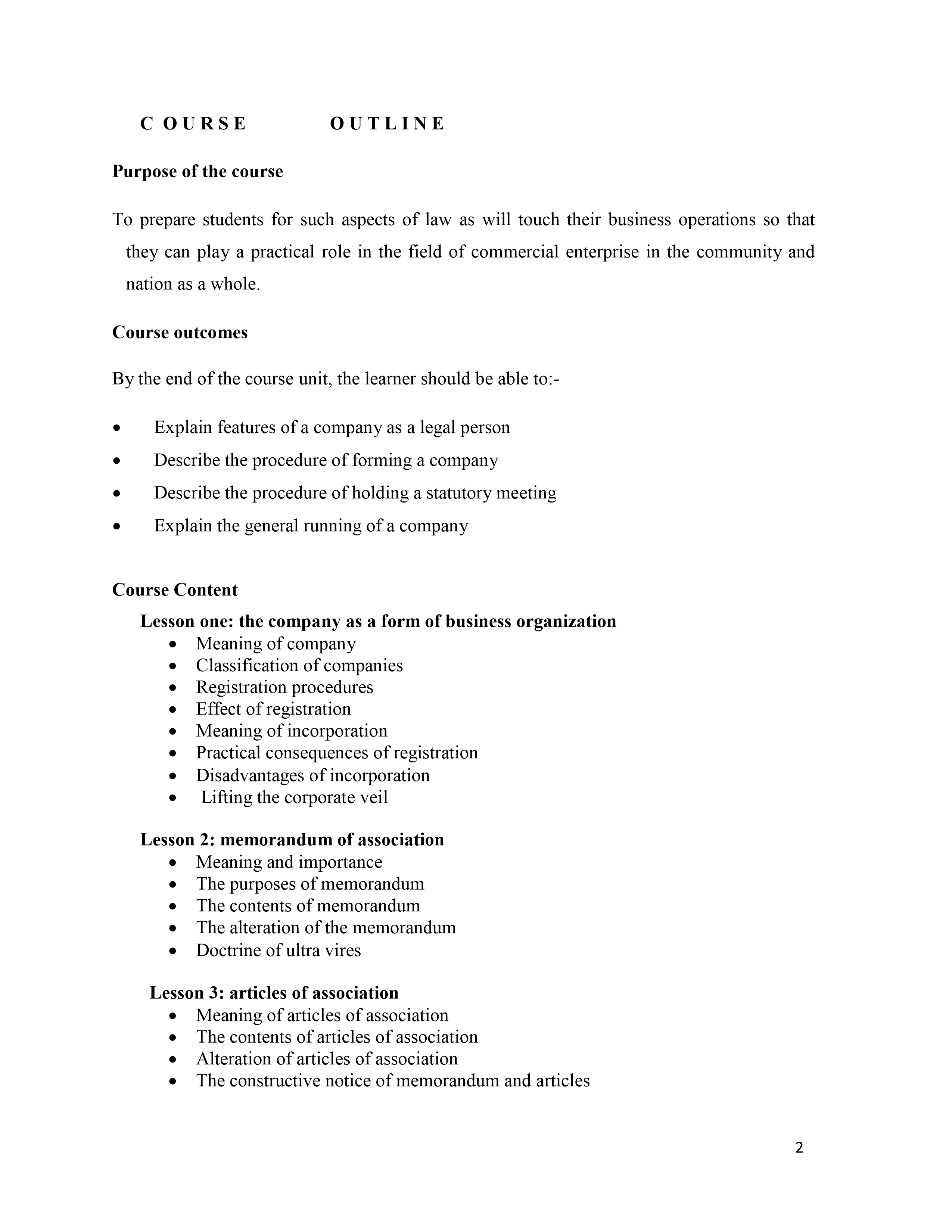
Purpose of the course is to prepare students for such aspects of law as will touch their business operations so that they can play a practical role in the field of commercial enterprise in the community and nation as a whole.
Below is the document preview.

KAPSABET HIGH SCHOOL POST-MOCK 2024; Mathematics PP1 & PP2 Q&A
Trending!
Download a copy of the KAPSABET HIGH SCHOOL POST-MOCK 2024; Mathematics PP1 & PP2 Question Papers with well coordinated Marking Schemes attached. This is a good revision material for your upcoming exams.
60 Pages
10322 Views
5 Downloads
3.84 MB
KAPSABET HIGH SCHOOL POST-MOCK 2024; English PP1,PP2 & PP3 Q&A
Trending!
Download a copy of the KAPSABET HIGH SCHOOL POST-MOCK 2024; English PP1,PP2 & PP3 Question Papers with well coordinated Marking Schemes attached. This is a good revision material for your upcoming exams.
35 Pages
10284 Views
1 Downloads
2.46 MB
KAPSABET HIGH SCHOOL POST-MOCK 2024; Biology PP1,PP2 & PP3 Q&A
Trending!
Download a copy of the KAPSABET HIGH SCHOOL POST-MOCK 2024; Biology PP1,PP2 & PP3 Question Papers with well coordinated Marking Schemes attached. This is a good revision material for your upcoming exams.
38 Pages
9325 Views
1 Downloads
3.42 MB
KAPSABET HIGH SCHOOL POST-MOCK 2024; Chemistry PP1,PP2 & PP3 Q&A
Trending!
Download a copy of the KAPSABET HIGH SCHOOL POST-MOCK 2024; Chemistry PP1,PP2 & PP3 Question Papers with well coordinated Marking Schemes attached. This is a good revision material for your upcoming exams.
47 Pages
9705 Views
4 Downloads
3.33 MB
KAPSABET HIGH SCHOOL POST-MOCK 2024; Kiswahili PP1,PP2 & PP3 Q&A
Trending!
Download a copy of the KAPSABET HIGH SCHOOL POST-MOCK 2024; Kiswahili PP1,PP2 & PP3 Question Papers with well coordinated Marking Schemes attached. This is a good revision material for your upcoming exams.
43 Pages
11897 Views
13 Downloads
2.48 MB
APS 402: COGNITIVE PSYCHOLOGY
Trending!
Cognition is a key aspect in lives of human beings. It is the aspect of human life that controls all the mental process as well as the activities in our daily lives. To be able to use our limbs, to communicate with people or to learn and perform a specific task we apply our cognitive resources. In essence cognition is omnipresent in all aspects in our lives. On the other hand psychology is a study of the mind and behavior. Through psychology, we learn about our emotions, our thought process and our behavior. Cognitive psychology helps us to understand our emotions, our thoughts and our behavior in response to our emotions and thoughts. We are also able to understand other
people that we interact with based on psychology of our cognition. In this unit you will learn how cognitive process affects our thoughts, emotions and behavior. This will help you understand yourself better and those you interact with.
105 Pages
8065 Views
0 Downloads
1.17 MB
APS 212 :CHILD PSYCHOLOGY
Trending!
In this section we are going to introduce what child psychology is.
Child psychology is also referred to as child development. It is the study of the psychological processes of children and, specifically, how these processes differ from those of adults, how they develop from birth to the end of adolescence, and how and why they differ from one child to the next. Child psychology represents an approach to understanding children through a description and an explanation of the psychological changes which children undergo in the course of time. For example as children grow older they form attachments to people, acquire language and learn to behave in ways that are rewarding. They become able to regulate their own behavior.
100 Pages
2942 Views
0 Downloads
1.65 MB
APS 201 :INTRODUCTION TO PSYCHOLOGY OF PERSONALITY QUESTIONS & ANSWERS
Trending!
Questions and answers to APS 201 :INTRODUCTION TO PSYCHOLOGY OF PERSONALITY paper.
27 Pages
10507 Views
0 Downloads
336.68 KB
APS 417: BLENDED MODULE SCHOOL PSYCHOLOGY
Trending!
Good Student, you are most welcome to this module I suppose that you have interacted with learning and more so psychology in your schooling. I suppose that you have heard about school psychology and probably come up with your own version of the meaning and what it entails in the field of psychology and learning especially when it relates to yourself, your colleagues, family siblings, community and the general society in which education is being emphasized by the government. There has been issues of education for all ideology, global and national millennium development goals of education, and Kenya’s vision 2030 where one of the pillars of expected developmental reforms is basically education. All this indicate that that schooling for all children becomes a key focal issue in the current government In this module, we will introduce you school psychology and explore the rationale for studying it and possible integrating it in our day today learning from psychological point of views in order to enhance effective and efficient learning and holistic wellness among teachers, students, management and even home environments.
124 Pages
6836 Views
0 Downloads
3.06 MB
APS 412 :INDUSTRIAL/ORGANIZATIONAL PSYCHOLOGY
Trending!
Job Analysis
Personnel Recruitment and Selection
Performance Appraisal
Individual Assessment
Psychometrics
Remuneration and Compensation
Training and Training Evaluation
Employee Motivation
18 Pages
7695 Views
0 Downloads
394.46 KB