Financial Markets and Institutions
| Institution | UNIVERSITY |
| Course | FINANCE |
| Year | 1st Year |
| Semester | Unknown |
| Posted By | Mwalimu Evans Okoyo. |
| File Type | |
| Pages | 140 Pages |
| File Size | 3.24 MB |
| Views | 1416 |
| Downloads | 0 |
| Price: |
Buy Now
 Buy via
whatsapp Buy via
whatsapp
|


Description
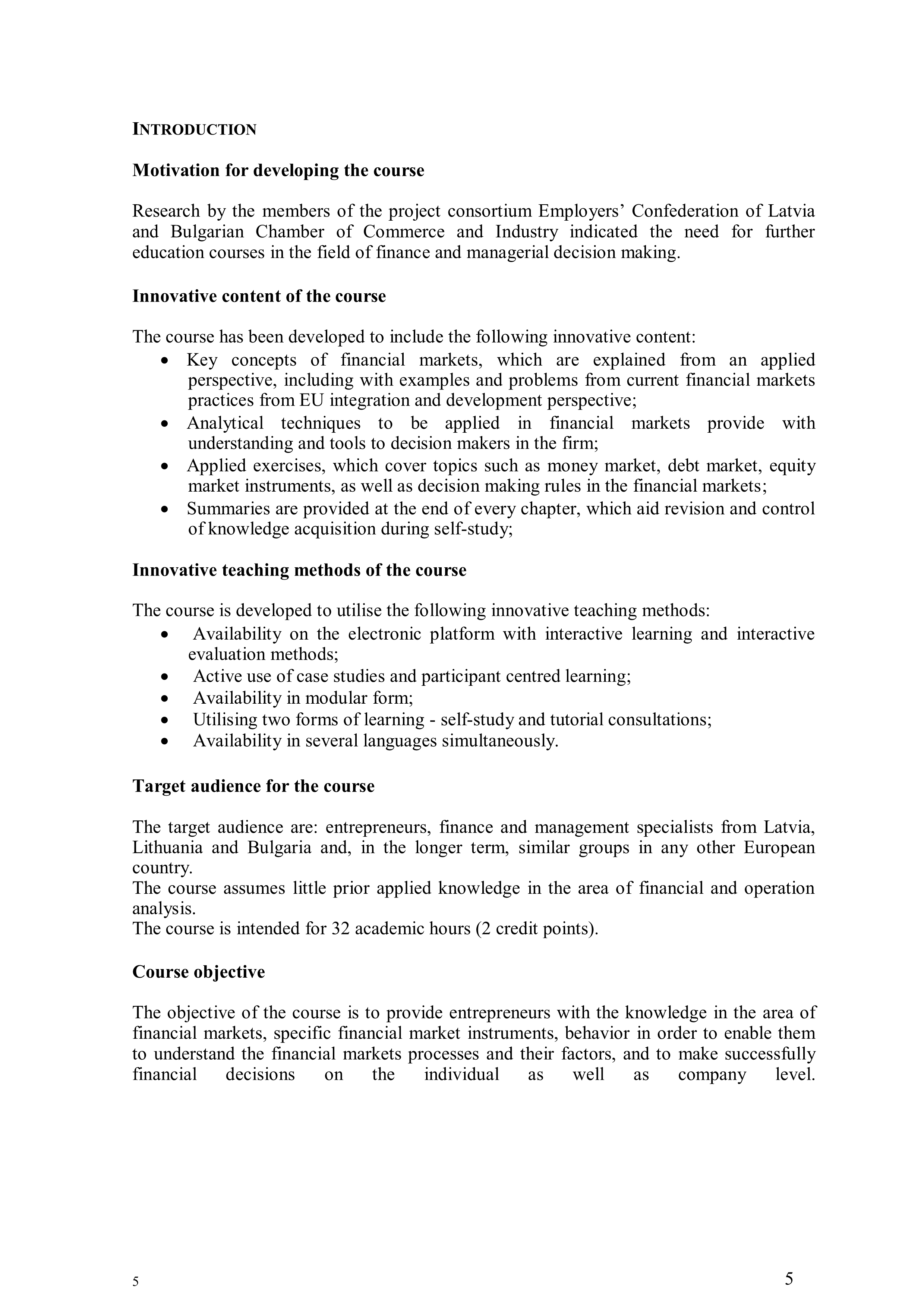
Research by the members of the project consortium Employers’ Confederation of Latvia and Bulgarian Chamber of Commerce and Industry indicated the need for further education courses in the field of finance and managerial decision making.
Below is the document preview.

BAC 305: FINANCIAL MARKETS AND INSTITUTIONS
Trending!
The financial system can also be defined as the collection of markets, institutions, laws, regulations, and techniques through which financial instruments (bonds, stocks, and other securities) are traded, interest rates are determined, and financial services are produced and delivered around the world.
163 Pages
9735 Views
0 Downloads
2.11 MB
BAC 305 Financial Markets and Institutions
Trending!
• Financial market is a market in which financial assets (securities) such as stocks and bonds can be purchased or sold
• Financial markets are critical for producing an efficient allocation of capital, which contributes to higher production and efficiency for the overall economy, as well as economic security for the citizenry as a whole
• Financial markets also improve the lot of individual participants by providing investment returns to lender-savers and profit and/or use opportunities to borrower-spenders.
152 Pages
7101 Views
1 Downloads
1.39 MB
Financial Markets and Institutions FITH EDITION NOTES
Trending!
In the 1990s, financial markets in the United States boomed. The Dow Jones Industrial
Index—a widely quoted index of the values of 30 large corporations (see Chapter 8 )—rose
from a level of 2,800 in January 1990 to more than 11,000 by the end of the decade; this
compares to a move from 100 at its inception in 1906 to 2,800 eighty-four years later.
In the early 2000s, as a result of an economic downturn in the United States and elsewhere,
this index fell back below 10,000. The index rose to over 14,000 in July 2007,
but (because of an increasing mortgage market credit crunch, particularly the subprime
mortgage market) fell back to below 13,000 within a month of hitting the all-time high. By
2008, problems in the subprime mortgage market escalated to a full blown financial crisis
and the worst recession in the United States since the Great Depression. The Dow Jones
Industrial Arerage (DJIA) fell to 6,547 in March 2009 before recovering, along with the
economy, to over 11,000 in April 2010.
850 Pages
6730 Views
0 Downloads
13.49 MB