Inorganic Chemistry III Notes
| Institution | University |
| Course | Chemistry |
| Year | 1st Year |
| Semester | Unknown |
| Posted By | Mwalimu Evans Okoyo. |
| File Type | |
| Pages | 79 Pages |
| File Size | 5.72 MB |
| Views | 3456 |
| Downloads | 0 |
| Price: |
Buy Now
 Buy via
whatsapp Buy via
whatsapp
|


Description
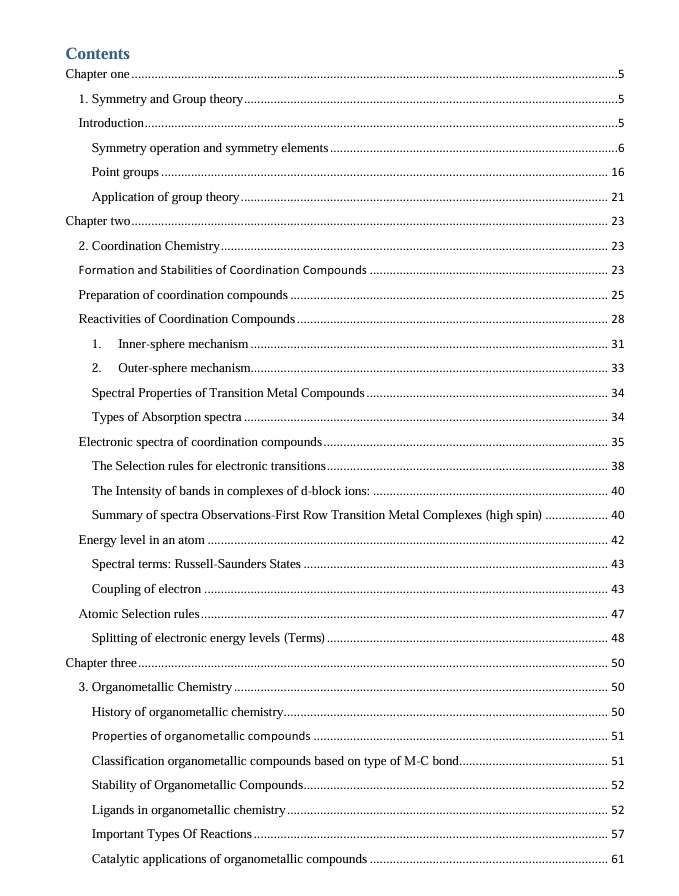
The document is a course module for Inorganic Chemistry III. It covers key topics such as symmetry, group theory, coordination chemistry, organometallic chemistry, and bioinorganic chemistry, emphasizing their principles and applications. The course aims to provide students with a comprehensive understanding of these concepts and their relevance in chemical reactions and properties.
Below is the document preview.

Criminal Psychology Lecture Notes
Trending!
The document outlines the field of Criminal Psychology, detailing its definition, scope, and the psychological theories related to criminal behavior. It discusses various types of crime, the criteria for defining crime, and methods for measuring crime and criminal behavior. Additionally, it highlights the roles and responsibilities of criminal psychologists in assessing offenders, aiding law enforcement, and providing expert testimony in court.
54 Pages
4267 Views
0 Downloads
931.86 KB
PRINCIPLES OF TEACHING SHORT NOTES
Trending!
This document discusses principles of teaching and learning styles. It defines effective teaching as demonstrating competency across seven domains: social regard for learning, learning environment, diversity of learners, curriculum, planning and assessment, community linkages, and personal growth.
24 Pages
3784 Views
0 Downloads
211.34 KB
PLANT SYSTEMATICS LECTURE NOTES
Trending!
This exploration of taxonomy, nomenclature, herbarium curation, botanical gardens, and
selected angiosperm families provides a detailed understanding of plant diversity, classification,
33 Pages
4078 Views
0 Downloads
960.25 KB
PLANT TAXONOMY LECTURE NOTES
Trending!
Taxonomy may be defined as the study and description of the variation of organisms, the investigation of the causes and consequences of this variation, and the manipulation of the data obtained to produce a system of classification.
45 Pages
4582 Views
0 Downloads
375.56 KB
BCE 206: ENGINEERING SURVEYING LECTURE NOTES
Trending!
Surveying is defined as “taking a general view of, by observation and measurement determining the boundaries, size, position, quantity, condition, value etc. of land, estates, building, farms mines etc. and finally presenting the survey data in a suitable form”. This covers the work of the valuation surveyor, the quantity surveyor, the building surveyor, the mining surveyor and so forth, as well as the land surveyor.
78 Pages
4362 Views
0 Downloads
2.07 MB
BBY 3108: INVERTEBRATE ZOOLOGY SHORT NOTES
Trending!
An invertebrate is any animal without an internal backbone which includes animals such as insects, crustaceans, worms, jellyfish and sponges. The diversity of invertebrate species far outnumbers that of the vertebrate animals. One group of invertebrates called Arthropods, which includes insects, spiders and crustaceans, contains almost 80% of all animal species. The remaining invertebrates constitute between 12-15% of all animal species.
99 Pages
4133 Views
0 Downloads
1.11 MB
BUSINESS MANAGEMENT EXAMS SHORT REVISION NOTES
Trending!
The document provides an introduction to management, discussing its definition, characteristics, levels, and key functions including planning, organizing, staffing, directing and controlling. It defines management as getting things done through others and outlines that it is a universal, purposeful, integrative and continuous process.
12 Pages
4092 Views
0 Downloads
297.32 KB
HISTOLOGY OF FIBROUS CONNECTIVE TISSUE
Trending!
Definition and classification
Cells
Tissue responsible for support, connects or separates different types of tissues and organs
Composition
Extracellular matrix (abundant)
Protein fibres
Amorphous ground substance
Tissue fluid (constant)
23 Pages
3681 Views
0 Downloads
6.41 MB
Development of Chorion and placenta
Trending!
Fetal membranes are membranous/auxiliary
structures that surround or associated with vertebrate
embryo but do NOT take part in final embryo
formation.
Include:
1-Amnion.
2-Yolk sac.
3-Allantois.
4-Connecting stalk and umbilical cord.
5-Chorion
38 Pages
4428 Views
0 Downloads
10.11 MB
PLACENTA, FETAL MEMBRANES AND MULTIPLE GESTATION
Trending!
DEVELOPMENT OF THE CHORIONIC SAC
• Trophoblast layer of the blastocyst
• Differentiation into: – Cytotrophoblast – inner layer – Syncytiotrophoblast – outer layer
• Development of extraembryonic mesoderm
• Formation of isolated lacunae spaces which later coalesce to form one big extraembryonic cavity – renamed chorionic sac
• Chorionic sac surrounds the amniotic cavity and primary umbilical vesicle
• Expansion of chorionic sac reduces the size of umbilical vesicle
130 Pages
3789 Views
0 Downloads
3.06 MB