DATABASE
| Institution | UNIVERSITY |
| Course | INFORMATION COMMUNIC... |
| Year | 1st Year |
| Semester | Unknown |
| Posted By | Brian Mike |
| File Type | |
| Pages | No pages found |
| File Size | 629.11 KB |
| Views | 1021 |
| Downloads | 0 |
| Price: |
Buy Now
 Buy via
whatsapp Buy via
whatsapp
|


Description
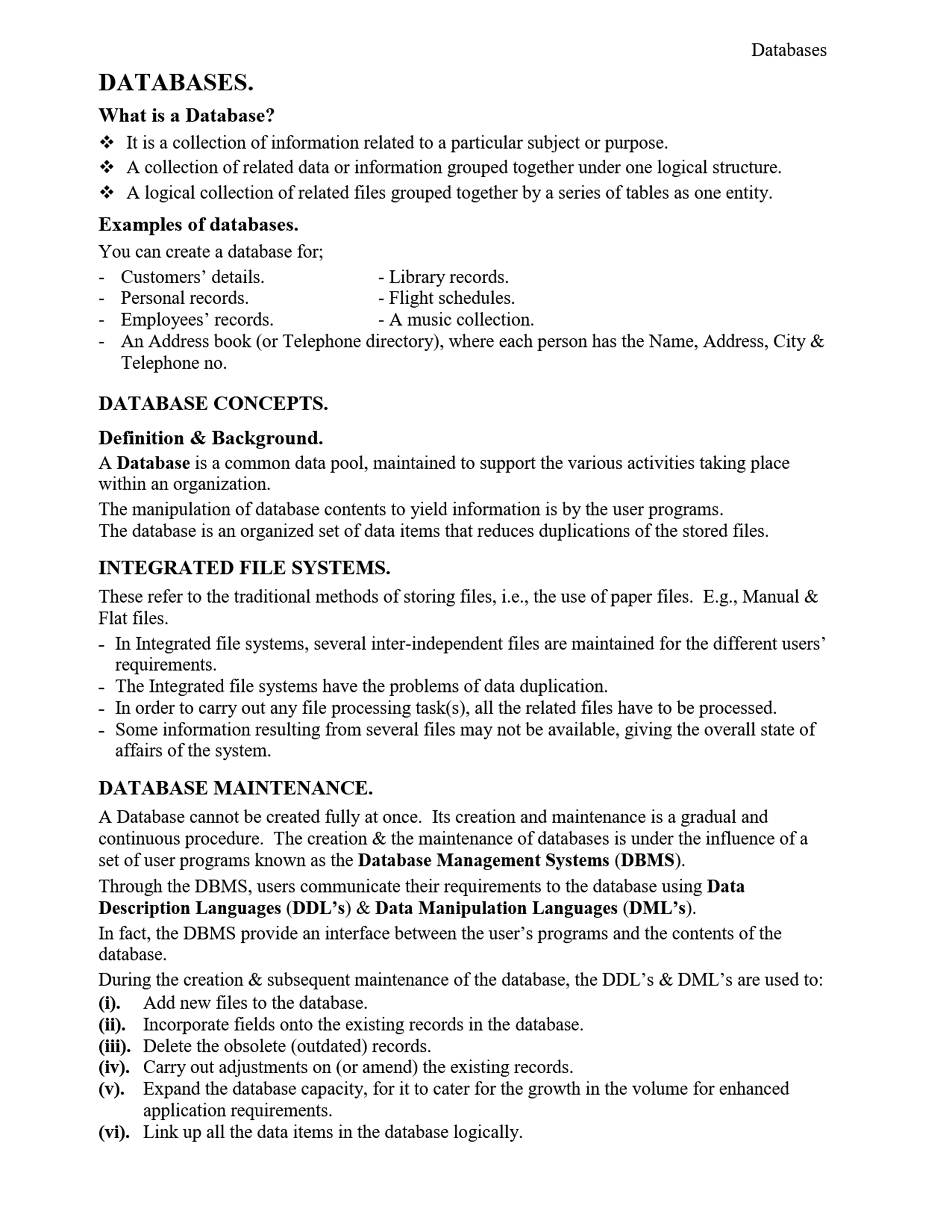
Database is a common data pool maintained to support the various activities taking part in an organisation
Below is the document preview.

Database Management System
A Database Management System (DBMS) is software designed to store, manage, and retrieve data efficiently in a structured manner. It serves as an interface between users and databases, allowing for data organization, retrieval, modification, and management without requiring users to understand the complexities of database structures.
837 Views
0 Downloads
183.97 KB
Database Recovery Techniques
Trending!
Database recovery techniques are methods used to restore a database to a consistent state after a failure. Failures can be caused by hardware issues, software bugs, or user errors. The primary goal of these techniques is to ensure data integrity and minimize data loss.
3617 Views
0 Downloads
559.49 KB
Distributed Database System
Trending!
Distributed Database System (DDBS) is a collection of databases distributed across multiple locations, interconnected by a network, and managed in such a way that they function as a single logical database. This system allows data to be stored, processed, and accessed from multiple sites, enhancing performance, reliability, and scalability.
3806 Views
0 Downloads
253 KB
Database Security
Trending!
Database security refers to the collective measures and technologies implemented to protect databases from unauthorized access, misuse, corruption, or theft. It involves safeguarding the data, the database management system (DBMS), and associated applications to ensure confidentiality, integrity, and availability.
3660 Views
0 Downloads
1.01 MB
Database development Lifecycle
Trending!
The Database Development Lifecycle (DBLC) is a structured process for designing, implementing, and maintaining a database system to meet specific organizational needs. It consists of several phases: requirements analysis, where data needs are identified; conceptual design, where data relationships and models are created; logical design, where data structures are refined for the database management system; physical design, involving the implementation of the database on specific hardware and software; implementation, where the database is developed and populated with data; and testing, deployment, and maintenance, ensuring functionality, performance, and updates as needed. This lifecycle ensures systematic development, scalability, and efficient data management.
3887 Views
0 Downloads
38 KB
Database Integration for mobile devices
Trending!
Database integration for mobile devices refers to the process of connecting mobile applications with backend databases to store, retrieve, and manipulate data. This integration enables mobile apps to manage user data, synchronize content, and perform complex operations in real time. Mobile devices often rely on cloud-based databases or local storage solutions to ensure smooth functionality, even with intermittent connectivity. Common technologies for database integration include RESTful APIs, GraphQL, SQLite, Firebase, and cloud platforms like AWS or Google Cloud. Proper integration ensures data consistency, security, and optimal performance across diverse mobile environments.
3128 Views
0 Downloads
998.78 KB
SCO 233: FUNDAMENTALS OF DATABASES PAST PAPER
Institution:
Year: 2023/2024
Semester: 2nd Year, 2nd Semester (2.2)
ISC 843: DATABASE MANAGEMENT SYSTEM PAPER PAST
Trending!
Institution:
Year: 2022/2023
Semester: 6th Year, 1st Semester (6.1)
ISC 843: DATABASE MANAGEMENT SYSTEM PAST PAPER
Trending!
Institution:
Year: 2022/2023
Semester: 6th Year, 1st Semester (6.1)
ISC 305: DATABASE MANAGEMENT SYSTEM PAST PAPER
Institution:
Year: 2022/2023
Semester: 3rd Year, 1st Semester (3.1)